Showing posts with label green. Show all posts

Thursday, March 19, 2009

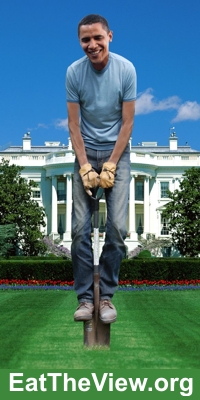
Local Food Movement comes to the White House: Obama Plants a Garden!

For months, numerous groups and individuals have been petitioning the new administration to be the symbol for all American's the follow -- to lead by example and plant an organic food garden at the White House. Well the dream is becoming an reality.  Tomorrow (March 20th, the first day of Spring), Michelle Obama will break ground on a new garden on the South Lawn of White House.

As reported by The Washington Times, the 1,100 square foot garden will include 55 kinds of vegetables, berries, herbs and two bee hives for honey that will be tended by a White House carpenter who is also a beekeeper. The list of produce was chosen by White House chefs and the harvested food will be used to feed the first family daily, for state dinners and other official events.

Better yet, the garden will be organic using only organic seedlings, soil and fertilizers.  The total estimated cost for all the materials...$200.  

As reported by the New York Times, the plots will be in raised beds fertilized with White House compost, crab meal from the Chesapeake Bay, lime and green sand. Ladybugs and praying mantises will help control harmful bugs. 

Don't we all wish we had this garden?

Alice Waters has been lobbying the White House for a garden since 1992. "It just tells you that this country cares about people's good health and about the care of the land," she said. "To have this sort of 'victory' garden, this message goes out that everyone can grow a garden and have free food."

“A real delicious heirloom tomato is one of the sweetest things that you’ll ever eat,” said Michelle Obama. “And my children know the difference, and that’s how I’ve been able to get them to try different things." 

I hope all American's will take this lead, plant and garden and find out what a real tomato taste like. 

Friday, January 16, 2009

Martin Luther King and a 7-Year-Old: Same Dream, Different World

I think this image speaks for itself...

.   

What can you do to make this world a better place? Let me know and I will Twitter about each response as they come it. Or you can just send me a message on Twitter.  You can follow me on Twitter at @Green_Luvin.

Sunday, January 11, 2009

Vote Change One More Time -- For Our Food System

I think many of us agree that our food system is a mess.  Our industrial ways are destroying our environment and health.  We had hope that Obama would pick a Secretary of Agriculture that would be good for our future but that took a down turn. His choice in Tom Vilsack is bad but there appears to be a glimmer of hope, a very small one, that he might become the Secretary of Commerce as reported by the New York Daily News the other day. But to date it appears that is is all rumor. Check out my new favorite blogs, Obama Foodorama, for an explanation on why the Vilsack move is the best choice for America's food system.  I can tell you we are hoping Obama is listening. 

Now there has been a lot of talk lately that the overhaul of our food system is going to take a back burner to the economy. But as Michael Pollan and Grist's Tom Philpott argue, and I agree, investing in a new food system should be part of the economic stimulus package. Ignore it and we continue along, on our way to massive environmental and public health catastrophes. 

In a recent article entitled "Eat the Stimulus," Philpott lays out a plan to overhaul America's food system that he believes would not require a new program or major expenditure of political capital. In short, Philpott suggest that a bulk of the economic stimulus package should go to support local and regional food systems. "Reviving that infrastructure would significantly lower costs for the sort of pasture-based, sustainable meat farmers who are now badly undercut on price by large-scale, environmentally ruinous producers," writes Philpott. He also recommends a reinvestment in our school cafeterias and feed our children healthy, unprocessed food --teaching them that our food comes from the earth not a grocery store. Sounds like a great plan to me but I feel that us sustainable foodies have an uphill battle. 

One way we can try and make a difference is to be a part of the Change.org campaign. On January 16, Change.org and the Case Foundation are co-hosting an event at the National Press Club in Washington, DC to announce the top 10 rated ideas that have been submitted by Americans across the country. They plan on then launching a national campaign behind each idea using the collective energy of the millions of members of Change.org, MySpace, and partnering organizations to ensure that each winning idea gets the full consideration of the Obama Administration and Members of Congress.

Both Eat the View and The Who Farm have been petitioning the next president to plant an organic garden on the White House lawn.  I previously wrote about them in my post entitled "A Victory Garden at the White House?" The two groups have gotten together to put the idea on Change.org and the idea is currently (as I type) in 24th Place and needs 2861 more votes to be part of the final 10 ideas presented at the event in Washington, DC.  

The idea as stated on Change.org, Victory Garden 2.0:
Thousands of Americans and people from the around the world are asking the Obamas to lead by example on climate change, health policy, economic self-reliance, food security, and energy independence by replanting an organic food garden at the White House with the produce going to the First Kitchen and to local food pantries.

The many successes(1) of the first Victory Garden movement were the result of effective public policy, bold leadership(2) at a time of national crisis, and the commitment of millions of citizens who were ready to roll up their sleeves for the greater good.

There' s no better, more symbolic place for launching a new National Victory Garden Program than at the White House, "America’s House". There's no better, more urgent time(3) than now. And there's NOTHING that can beat the fresh taste of locally-grown, home-cooked foods.
The number one idea on Change.org is "Legalize the Medicinal and Recreational Use of Marijuana." Now I am actually in favor of this idea but I do not believe it is worthy of getting the attention that Change.org plans to put forth. There are much greater and important issues. Having a organic garden at the White House will really put the importance of our food system front and center. And then if a majority of American's follow the lead of growing their own food, our agricultural system will be forced to change without the force of the government.  

So please vote.  Voting ends at 5pm ET on January 15th. You can vote by clicking here or click on the image below.  You must register on the site but in only takes one second of your time.  If all of us vote we can definately put Victory Garden 2.o in the top 10.  Let's help make a change in our food system.

Saturday, December 20, 2008

Soda Lovers Learn Waste Management

On the homepage of the Container Recycling Institute is a counter clocking how many beverage containers have been landfilled, littered and incinerated in the United States. This year alone the counter has tallied over 123 billion bottles and cans. Amazingly, the average American drinks around 60 gallons of soda each year, sadly, only 33-45 percent of those bottles and can get recycled. The environmental toll from the production, packaging and shipping of each soda can and bottle is incredible – the energy wasted in 2001 to produce 50.7 billion soda cans was the equivalent to 16 million barrels of oil!  Our towns and cities are being buried in water and soda bottles and cans. 
 (Image: Rich Pedroncelli/AP)

With the economy in the dumps-- no pun intended-- the problems arising from these drink containers is getting even more severe.  Plainly said, at this moment in time, there is no market for recyclables. Paper, plastic, aluminum, cardboard, all those products we are so proud to put in our recycling bins and put on the curb for pick up are piling up at municipal recycling facilities.  A once lucrative business, recyclers cannot find anyone to buy there "junk".  

According to a December 7th story in the New York Times entitled Back at Junk Value, Recyclables are Piling Up, in some areas mixed paper is selling for $20-25 a ton, down from $105 in October and tin is now $5 a ton, down from $327 earlier this year.  Some towns and cities across country that used to get paid for their recyclables are either not getting their monthly checks or are now being charge to take the junk away.  

I recently spoke with public works representative in my town who told me that our township was getting paid for all our recyclables but the checks had stopped coming.  However, they told me that our town is lucky because we are in a contract with a hauler, so our recyclables were still getting picked up. In many towns without rock-solid contracts, recyclable haulers are refusing to pick up their loads.  

So now what?  Clearly we should not abandon our recycling programs. I know I've painted a bleak picture, but it is really important to continue to recycle.  However, now more than ever, the first two of the 3 "R's"s are increasingly more important.  We need to REDUCE and REUSE.
 
Between 1960-79 the average person purchased 200-250 packaged drinks per year. In 2006 that number has soared to 686 drinks (Source: Container Recycling Institute).  We need to turn this around and reach for zero new waste. We need to make consumer choices to buy products that are not only recycled and recyclable, but to buy goods that do not generate more recyclable garbage.  Sounds hard right?  Well in some instances its not as difficult as you might think.

In my house we've taken an interesting step in this direction. We drink a lot of soda water (seltzer).  At least a 1/2 gallon a day.  Now my husband and I used to drink Peligrino by the case.  Doing so would put at least 6-8 glass bottles back into the garbage/recycling stream on a weekly basis. In addition, our sparkling water traveled thousands of miles to reach us. A gallon of Peligrino costs over $7.50 per gallon, much more than gasoline. 

Recently, we got the opportunity to try out Sodastream Soda-Club, a home seltzer and soda-making machine. The machine is already helping eco-conscious consumers elsewhere - 30% of German and 24% of Swiss households have soda machines and have reduced their waste.  With a Soda-Club machine, we drink freshly made, great tasting seltzer and we are drastically reducing waste from store-bought cans and bottles. The machine uses no batteries or electricity, just a 14.5 oz CO2 canister that can make up to 60 liters of seltzer or soda. Empty carbonators are returned to Soda-Club to be cleaned, inspected and refilled with CO2 drawn naturally from the air. Carbonators are reusable as long as they remain in good condition. 

We tried a machine that is called the Penguin. This little marvel comes with 2 glass carafes. Other versions come with clear plastic (PET), BPA-free reusable bottles will about 3 years. Each bottle also comes with a special cap with a hermetic seal that keeps your soda carbonated long after you first open it and it really works. 

The machine's also come with regular, diet and caffeine-free flavors to make cola, root bear, cherry soda and many more. In addition they have fruit essence to make flavored-seltzer. If you are purist like me these syrups may not pass the test. But for those of you who still need your soda fix, it beats drinking high-fructose Coca-Cola. Regular flavors have 2/3 less carbs, calories and sugar than store-bought sodas, and contain much less sodium. Both regular and diet flavors do contain Splenda®. 

For our household we are sold. We always have fresh bubbly seltzer in the house. Finish a bottle during a meal, just fill the bottle with water, stick it in the machine press the lever and we have seltzer in seconds. According to Carbonrally, we save about 6 lbs of carbon emissions per week (production, bottling, transport) by making our own soft drinks. According to Soda Club, worldwide, they estimate over 10 million units have been sold.  That is huge savings worldwide in carbon emissions, bottles and cans.
  
So if you are like me and want to still recycle but REDUCE your waste dramaticly, I suggest giving a Soda-Club machine a try.  The machines range from about $100 to $230 dollars depending if you order just a machine or a machine with flavors.  All machines come with CO2 carbonators.  It may sound a little steep but the savings on your waste, environmental impact and future costs (pay back depends on how much you drink), it is well worth it.  AND Soda-Club is giving Green Luvin' readers a discount.  Use the discount code MELISSA at check out you will get an additional $5 off after their current holiday discount, a total savings of $25 per machine.  

Friday, November 7, 2008

An open letter to President-elect Obama.

Dear President-elect Obama, 

After a long, hard and contentious campaign you've won the Presidency of the United States. Congratulations. Take a moment to enjoy your success. Ok, that was long enough. Now let's down to business.  

You well know that you have a long hard road ahead of you, but your first order of business is to choose a cabinet that is strong, thoughtful and will move this country in the right direction. In my opinion, and in the opinions of many people like me, administration environmental jobs should a top order of business. Our crumbling economy will not matter if we cannot breath our air, drink our water, or eat our food. Relieving the credit crunch won't make a difference if rates of obesity, cancer, diabetes, heart disease continue to rise. Keeping people in their homes, empowering people to buy new cars will become meaningless unless we fix the food system, the water system, and limit the spread of untested genetically modified organisms (GMOs). That is why I am calling out to you to take a good look at who you appoint as Secretary of Energy, Head Administrator of the Environmental Protection Agency, Secretary of Interior, Secretary of Agriculture and possibly the new position, Climate Change Czar -- or make this a function of the Department of Homeland Defense.

Of all the cabinet level posts you will fill, there is one that is usually a second thought, but in my opinion is as important as State, Treasury and Defense -- the Secretary of Agriculture. Our food system is in dire need of a change and the right person might be able to help begin the overhaul necessary. 

The Secretary of Agriculture oversees food safety and sets farm policy.  He/she makes recommendations to Congress on which crops should be subsidized, how agricultural laws are enforced, crop-land conservation, and setting the nations nutritional standards and even organic labeling. They also oversee our food stamp program, food distribution during disaster relief efforts, the US Forest Service and the food that is fed to our children in school. That's a big job.

I have read that former Iowa Governor, Tom Vilsack is on the short list for this position. From the corn state, Vilsack strongly supports ethanol subsidies. He believes that he has changed the corn fields of Iowa into energy fields. To me that sounds like a shift in use, not better agriculture or energy policy. As he stated in an op-ed in the Argus Leader, "If you drive across Iowa today, you will see a changing landscape marked by new ethanol and biofuel production plants and wind farms. As a state, we became more economically, environmentally and energy secure." Today, Iowa farmers are still hurting the soil and water by using petroleum-based pesticides and fertilizers. Furthermore, these farmers have shifted corn from feeding the world to ethanol production, which, as we all know, is not helping increase our independence from foreign oil. But with all his good intentions, former Governor Vilsak is too much of an insider to create really change.

I have also read that your short list includes Tom Buis the President of the National Farms Union and the Congresswoman for South Dakota Stephanie Herseth Sandlin. These two are also agriculture "insiders" who are in the pocket of industrial agriculture who might working in the best interest of the farmers they represent, mostly corporate farming, but neither are strong enough or creative enough to achieve real change we need in the system.

Then there is former Congressman Charles Stenholm (D-TX). Charlie is a conservative Democrat that joined the Republicans to kill a bill that would have prevented sick cattle that are unable to walk from entering the US food supply. (Remember the video released by the Humane Society of downer cows?) While part of the House Agriculture Committee he received more than $800,000 in PAC contributions and took numerous trips sponsored by agriculture lobbyist groups. After leaving Congress he became a lobbyist for the agriculture and food industry. Again, not someone who is going to change our system for the better.

So by now President-elect Obama you must say, well then who? There is one man out there who is not already in politics, who has examined our foods system from farm to table, and who understands the impact it plays on our environment, our economy and our health. He has intimate knowledge of not only farmers, but also diaries, feed-lots, and food processors. He is not a Washington insider and to top it off he has already laid out a plan for tackling the issues we face. His plan takes into account the impact agriculture has on our climate, energy dependence, the healthcare system, foreign and trade policies and national security. As states in his own words:
We need to wean the American food system off its heavy 20th-century diet of fossil fuel and put it back on a diet of contemporary sunshine. True, this is easier said than done — fossil fuel is deeply implicated in everything about the way we currently grow food and feed ourselves. To put the food system back on sunlight will require policies to change how things work at every link in the food chain: in the farm field, in the way food is processed and sold and even in the American kitchen and at the American dinner table. Yet the sun still shines down on our land every day, and photosynthesis can still work its wonders wherever it does. If any part of the modern economy can be freed from its dependence on oil and successfully resolarized, surely it is food.
The scribe of this plan called the Sun-Food Agenda is Michael Pollan, the Knight Professor of Journalism at the Graduate School of Journalism at UC-Berkeley, director of the Knight Program in Science and Environmental Journalism and author.

President-elect Obama I urge you to read Professor Pollan's plan as laid out in an article in the New York Times Magazine entitled "Farmer In Chief" and stick with what you have been saying throughout your campaign, that America needs real change. I urge you to consider Michael Pollan for the Secretary of Agriculture. (Or at least consult with him to mine his knowledge on the issues to make the best choice possible for the position.)

Pollan's plans are not liberal.  They are not conservative.  They are what is best for America.  And most importantly they are achievable.

As Pollan states:
[The] sun-food agenda promises to win support across the aisle. It builds on America’s agrarian past, but turns it toward a more sustainable, sophisticated future. It honors the work of American farmers and enlists them in three of the 21st century’s most urgent errands: to move into the post-oil era, to improve the health of the American people and to mitigate climate change. Indeed, it enlists all of us in this great cause by turning food consumers into part-time producers, reconnecting the American people with the American land and demonstrating that we need not choose between the welfare of our families and the health of the environment — that eating less oil and more sunlight will redound to the benefit of both.
This is a new era for America and Michael Pollan may just be The Change We Need.

Yes We Can!

Best,

Green Luvin'

Sunday, November 2, 2008

A Victory Garden at the White House?

The next U.S. president is going to have the daunting task of fixing all that has gone wrong in this country. However, I believe that both candidates are overlooking an extremely important issue -- our food system. As Michael Pollan said on WNYC's Leonard Lopate Show, “It’s true that neither candidate has talked about food policy very much. Some of the issues they have talked about — energy independence, climate change and the health care crisis — I think they will find, as soon as they get into office, that you can’t deal with any of those three problems without dealing with the food system.” 

Last month Pollan wrote an article in the New York Times Magazine which was an open letter to the next president called "The Farmer In Chief" where he laid out what is wrong with our food system and what needs to changed. The article has too many important points to lay out here so please read it.  However, I will highlight one. Pollan concludes his piece with saying that the White House needs to set an example for the rest of the world. I am a firm believer in setting an example for others whether they be our children, our friends or for the next president -- the country.  

Pollan recommends that the next President needs to create a new post -- White House farmer -- who would be in charge of five acres of the White House lawn that would be turned into an organic fruit and vegetable garden. This may sound silly but as Pollan points out back in 1943 Eleanor Roosevelt started the Victory Garden movement, vegetable and fruit gardens planted to ease the burden on the food system during World War II. According to Pollan, by the end of the war more than 20 million home gardens were supplying 40 percent of the produce American's consumed. Victory Gardens today can help reduce our dependence on fossil-fuels and help address the problems of climate change.  

Well Pollan is not the only one who thought of using the White House as a national organic garden  -- two groups Eat the View and The Who Farm are petitioning the next president to plant an organic garden on the White House lawn.  

"Eat the View" is a campaign to plant healthy, edible landscapes in high-impact, high visibility places; whether it's the "First Lawn" or the lawn in front of your child's school. "Eat the View" is coordinated by Kitchen Gardeners International, a Maine-based 501c3 nonprofit network of 10,000 gardeners from 100 countries who are inspiring and teaching more people to grow some of their own food. Roger Doiron the founder of Kitchen Gardeners International just wrote his own letter to the next president entitled "Message to the candidates: Listen to Roger the Gardner" stating the importance of this issue.

TheWhoFarm (aka The White House Organic Farm Project) is a non-partisan, petition-based initiative who is requesting that our next president oversee the planting of an organic farm on the grounds of the White House. The farm will be a model for healthy, economical and sustainable living everywhere and serve as an educational tool and economic aid, and as a means to provide food security in the Nation’s Capitol while reconnecting the Office of the Presidency to the self-sufficient agricultural roots of America's Founding Fathers. TheWhoFarm have been traveling around the country educating Americans on the importance their mission in TheWhoFarmMobile, two school buses fused together with an organic edible garden on the roof.

Instead of a President that loves jelly beans or one that runs to McDonald's to get a Big Mac or one who hates broccoli, how about a president that walks out his front door and picks his own lunch -- or a least his farmer and chef do! Please sign both petitions. You can find the The WhoFarm petition by clicking here and the Eat the View petition by clicking here.

And don't forget to vote on Tuesday.  


Saturday, October 25, 2008

Going down the road feeling green.

Twenty years ago when I travelled all over the country to see the Grateful Dead, I always thought it would be cool to have a Westfalia VW van to travel around in. Cruising the parking lot of show I loved to poke my head in the Westfalia checking them out fantasizing about the owner's seemingly carefree life. Well that was a long time ago, and the idea has been stored way back in my subconscious, until now.


Flipping through Time Magazine's November supplement Style & Design I discovered the Westfalia Verdier Solar Power.  Created by Alexander Verdier, this hybrid camper is outfitted with solar panels that provide electricity for the on-board accessories while the vehicle is stationary.  There is an on-board computer and a GPS (Global Positioning System) that calculates the optimal position for the solar panels which are dubbed "Sun Tracker."

Some other improvements from the 1960's version include, a pneumatic suspension, which lowers the vehicle and sets its structure on the tires for improved comfort and a better stabilization in the stationary position. The sliding half-door on the passenger side that has an integrated folding staircase which makes the second stage area accessible from outside the vehicle. The passenger seat is transformed mechanically into stairs so that the second stage area (top level) can be easily reached from inside. A swivel cooking range makes it possible to cook outside as well as inside.  And of course, a multi-media computer with a wireless Internet connection.  To really see how cool this "van" is, check out out a video by clicking here.

Well Jerry Garcia is dead but the dream is alive today. I'm fantasizing right now about going with my husband and kids across country in this chic and environmentally friendly Westfalia rendition. Oh how I am ready to go on the road again! The Verdier will not be available until 2009 but they are taking reservations now.  Shoot, it's $129,000.  Ok the dream is dead.

Sunday, September 28, 2008

The Week in Green

I decided that there is so much "green" news out there each week that I would update you on what I think are the most interesting stories and topics.  So each week I will publish "The Week in Green."

If there is something that you think is interesting, topical or important, please post it to the comments here, on my Facebook Group (Green Luvin') and/or my Facebook blog, Green Luvin'.  You can also follow me on Twitter @Green_Luvin.

The Week in Green...

Be Green and Vote:  In most states you have until the end of the week to register to vote in the Presidential election.  Some say "why should I vote"?  No matter if you are a Republican or a Democrat, an environmentalist or a creationist (not sure why anyone would be), you MUST exercise your right to vote.  In this week Grist, Umbra Fisk wrote a piece called Citizen Bane: On the importance of voting.  A must read for all and if you have not registered to vote go to Declare Yourself to find out your state's deadline and all you need to register.


Bush's Environmental Record:  In a week that has once again exposed the incompetence of the Bush administration, the Republicans have boycotted a review of Bush's environmental record, as reported by the Environmental News Service. All of us know this administration has failed the American people on environmental and health issues while letting big business run rampant without oversight.  "For six years the administration sat by while oil imports increased, gas prices rose and global warming became more and more threatening," said Sierra Club Executive Director Carl Pope. "It refused to set higher fuel efficiency standards for vehicles even when the data showed that the current trajectory was actually hurting the U.S. auto industry, desiccating its market share."

Fast Food is transforming the waistlines of the Greek: Our fast and highly process foods are making the U.S. a nation of the overweight, sick and obese. We have been told that the healthful Mediterranean diet — emphasizing olive oil, fresh produce and fish -- is the way to go. But as reported in the New York Times this week, the Greeks have succumbed to our ways and are now seeing increased negative health effects from the change in their nation's diet.  So much so that the government has began lectures on nutrition in schools.  As stated in the article, "In Greece, three-quarters of the adult population is overweight or obese, the worst rate in Europe “by far,” according to the United Nations. The rates of overweight 12-year-old boys rose more than 200 percent from 1982 to 2002 and have been rising even faster since."  

The reusable shopping bag, green or not?:  If you're reading this, and you are, you probably have about a half a dozen or so reusable shopping bags.  Those of us who do, proudly bring them to the supermarket making our statement that we are taking one step in reducing waste and helping the environment. According to a story in the Wall Street Journal this week entitled "An Inconvenient Bag," reusable shopping bags are the new "it" freebie.  Sales are up 76% from this time last year.  Wow, what a business, but is it a green business? "Many of the cheap, reusable bags that retailers favor are produced in Chinese factories and made from nonwoven polypropylene, a form of plastic that requires about 28 times as much energy to produce as the plastic used in standard disposable bags and eight times as much as a paper sack, according to Mr. Sterling, of Natural Capitalism Solutions.

Reclaiming Cow Shit for Energy:  So many people dis on the cow because they feel that bovines are a leading causes of global warming.  They burp and fart methane. Well, a farm in Vermont is now taking the waste from their cattle and converting into clean burning natural gas to create a new and recurring source of green energy. The Green Mountain Dairy in Shelton, Vermont is part of an alternative energy program that converts methane from cow manure in to electricity.  Check out this interesting and progressive program by reading  Electricity From What Cows Leave Behind in the New York Times, The Business of Green section.

By the way, please don't print these stories out to read them.  Save the paper and read them online.

Tuesday, September 9, 2008

New study finds that you don't have to overeat to become obese.


Pollution contaminates our water, air, and land. It has been proven to cause asthma, allergies, cancer, emphysema, and whole host of other diseases. It causes global warming, kills our wildlife and now scientist from the Environmental Epidemiology at the Institut Municipal Investigacio Medica in Barcelona discovered it causes OBESITY.  

So in addition to fast foods and processed foods, pollution causes obesity? The Spanish study revealed that children who were exposed to a range of common chemicals and pesticides in the womb increased the childs chances of becoming obese. 

As reported in the journal Acta Paediatrica, scientists looked at the concentration of hexachloreobenzene (HCB) in the umbilical cord blood of 405 children born in Menorca from mid-1997 to mid-1998. Among those data point collected post birth, scientists looked at infant height and weight.  Feeding practices were reported by mothers in interviews at six months and one year after birth.  Additionally, the children’s height and weight were measured when they were 6.5 years old. The study revealed that children with the highest exposure to HCB were 2.5 times more likely to be overweight. The researchers also reported that these children were three times more likely to be obese than those with lower exposure levels. 

So, what is HCB? Hexachlorobenzene is a fungicide formerly used to treat seeds to control fungal disease. It was banned globally in the '90s under the Stockholm Convention which banned chemical substances that accumulate through the food chain, and pose a risk of causing adverse effects to human health and the environment. HCB has been banned in the US since 1965 but can still be found in our environment in 84 Superfund sites in the US and all across the world. It is a known animal cancinogen and a probable human carcinogen. Studies have found that HCB accumulates as your move up the food chain. Just like mercury, as it goes up the seafood food chain, HCB concentrations increase. Therefore, if you eat a large fish like tuna or swordfish that has been contaminated up the food chain, the concentrations of HCB would be extremely high.

So what else have children been exposed to prior to being born, and what impact might it have on my kids?

Previous studies have linked bisphenol A exposure to obesity in animals, and other studies have linked phthalates to obesity in adult men. As reported in the Telegraph in the United Kingdom, "The report's authors are now calling for exposure to similar pesticides to be minimised, including bisphenol A (BPA), used in baby bottles and cans of food, and phthalates, found in cosmetics and shampoos." Tests have shown BPA is found in 95% of Americans, while 90% have been found to be exposed to phthalates in the womb.

Between BPA, HCB, and phthalates, I'm frustrated and concerned. I would prefer to screw my kids up on my own and not worry about what their sippy cups or shampoos are made of, or what banned fungicides are in their foods.

What's keeping you up at night?

Tuesday, September 2, 2008

Junk mail, other than the annoyance, what's the problem? Lots...

If you're like me you love getting mail. The holiday cards, the thank you notes, etc. There is little more exciting than the sound of opening an envelope and reading a real piece of mail. But what I hate is the junk mail. Specifically the catalogues that clog my mail box and pile up day after day.

Well it turn out that more than 19 billion catalogs are mailed to households in the United States every year. That's 63 catalogs for each man, woman and child in the US. Well I wanted to put an end to this flood of useless mail.  I knew my family was getting a ton of these unwanted, unrequested catalogues from companies like LL Bean, Lands End, Victoria Secrets, Restoration Hardware and a whole host of other companies, well actually for me, eight-two companies. Eighty-two, that is how many different companies have sent me a mail-order catalogs in the past 2 months.  That is more than one catalog a day not including repeat catalogs! Wow that's a lot of junk mail.  

How do I know it is eighty-two?  About two months ago I began using Catalog Choice, a free service that contacts mail-order companies for you to remove your name from their mailing lists.  I knew I received a lot of catalogs but I had no idea that is was SOOO many.  

Using the Environmental Defense Fund paper calculator, Catalog Choice calculated the impact of all these catalogs on our environment. More than 53 million trees are need make 3.6 million tons of paper and 38 trillion BTUs of energy are need to produce the paper (enough to power 1.2 million households per year.) This process emits 5.2 million tons of carbon dioxide equal to annual emissions of 2 million cars -- significantly contributing to global warming. More that 53 billion gallons of wastewater is discharged to create the catalog paper -- enough to fill 81,000 Olympic-sized swimming pools.  This doesn't even take into account the amount of greenhouse gases emitted by the US Post Office from delivering these useless pieces of paper.

Since its launch last year, almost one million people have joined Catalog Choice and already opted out of 13,117,365 catalogs.  More than 1,000 companies have joined in to help people opt out of getting their catalogs but there are a few that have decided not to participate.  Out of the 82 companies on my list just Garnet Hill, Metropolitan Museum of Arts Store, Nordstroms, and Title Nine are not participating.  To date, 22 companies on my list have confirmed the opt out and Catalog Choice is still working on the rest.  

Catalog Choice is not the only service out there. For a fee, GreenDimes and 41pounds.org will get rid of unwanted junk mail and catalogs. OptOutPrescreen.com will stop unwanted credit or insurance offers. Even the Direct Marketing Association offers ways to remove your name and address for mailing list.  

It is so easy you have to try.  All you have to do is input them in and Catalog Choice does the rest.

Let me know how many catalogs you get rid of!


Thursday, July 31, 2008

Crunchy Greenolas: Organic and Natural Personal Care Products


Crunchy Greenolas is my own personal review of new green stuff I’ve found- I’ve tried everything and these are the goods!

• Kimberly Sayer of London - Kimberly Sayer is the daughter of organic farmer in England. Her family used fruits, vegetables, flowers and herbs to create their own skin, body and home care items.  Using this knowledge, she went on to study aesthetics, aromatherapy and chemistry and then launched her own organic product line.  All Kimberly Sayer products are USDA certified organic.  I have been using the Hydrating Antioxidant Facial Mask, Gentle Almond and Lavender Face Scrub, Restore Anti-Aging Cream and Cellular Extract Eye Lift Gel for the past month and my skin has never felt better. In addition, my family and I have been using the Organic Family Sunblock SPF 25 and it appears to work great.  My 5-year-old says it stings his skin but he has severe excema.  It has been great for my 2 year old. Kimberly Sayer's products can be purchased at select Whole Foods Markets and via her website. 

• suki  - suki produces two lines of products, suki pure skin and sukicolor.   suki pure skin is a 100% pure and 90% organic skin and body line (lotions, moisturizers, cleansers, toners, and hair products) and sukicolor is a pure and organic makeup line. The company sources all of their ingredients from fair trade, organic, biodynamic processing and local suppliers whenever possible. The company takes into consideration fuel emissions, as well as certification, and transport when making its purchasing decisions. The ingredients are 100% natural, food grade (not cosmetic grade) ingredients so that the products are non-toxic and edible (not that you want to eat it!). In addition, suki uses only biodegradable ingredients that do not hurt animals or damage the ecosystem and no toxic ingredients such as petrochemicals, chemical fragrances and preservatives. All suki products are packaged in eco-friendly materials like recycled stock, printed with vegetable ink and b0ttled in glass containers. The company's website not only explains all the ingredients but also lists ingredients to avoid. Now I have not tried everything in the both product lines but what I did try I really liked. Products can be purchase directly from the suki website or search on the site for a retail location in your area. Products are pretty price but are worth it.


• Artisan Naturals -- Started by Stephanie Barron, the mother of a child with allergies to synthetic fragrance and colorants, Artisan Naturals, is free of mineral oils, parabens and synthetic ingredients.  The product line includes cleaners, toners, moisturizers, mask and various skin treatments. In addition the company makes massage oils, candles and handcrafted soaps. The products are not certified organic but are made with organic ingredients and are all at least 99% natural. Artisan Naturals line can be purchase at a few speciality stories in the US and Europe in addition to the web via the company's site. Green Luvin' readers can receive 20% off the entire product line for the month of August by using the promotion code GRN08.

• Rare2b  - All vegan, all natural, organic, 100% botanical, vegetal, marine ingredients from non-gmo sources, Rare2b products do not contain parabens, alcohol, peg & tea, synthetic chemicals, petroleum by-products, formaldehyde or formaldehyde donors and no animal by-products. All the ingredients come from sustainable fair trade sources in the Amazon Rain Forest to the South Australian Rain Forest, which the USDA permits in certified organic food. The products are certified organic by Eco-Cert, the Forest Stewardship Council with USDA Organic Certification, and Kosher by the Federation of Synagogues and approved by the Fair Trade Foundation. The line includes day and night cream, facial mask and body lotion and can be purchased on the Rare2b website.

• The Grapeseed Company -- Based in the Santa Barbara, California wine region, The Grapeseed Company produces eco-friendly bath & body products using expeller-pressed grape seed oil, a natural byproduct of the wine making process. According to the company, grape seed oil is rich in antioxidants and vitamins and helps fight free radical damage and signs of aging. The grape seed oils are naturally expeller-pressed instead of solvent extracted. All colors come from the natural ingredients; there are no artificial additives or filler ingredients and ingredients are sourced from local sources whenever possible. The entire ingredient list can be found on the website and all ingredients are between 70% to 90%+ organic. My husband has been using the organic shave and skin care line for men line called Mojito Man and loves it! I keep having him try out different organic shaving products and this is the first one that he has liked and plans on only using this product line from now on. The company also makes body scrubs, bath & massage oils, lotions, lip balms and candles. All products can be purchase via The Grapeseed Company's website.  Green Luvin' readers can receive 10% off the total order by using the code 10AGAIN at checkout. 

If you know of any Crunchy Greenolas that you would like me to review or just think are great, please let me know.

Sunday, July 27, 2008

ENDoutdoor: New sustainable trail shoes for the green outdoor enthusiast

Many people think that when you live in the suburbs you are only surrounded by tiny plots of land with mowed lawns and white picket fences. Well that is not so. I am very fortunate to live within a half mile of a forest reserve of more than 2,000 acres of undeveloped land. Twice a week my friend and I take an 1-1.5 hour hike -- no matter the weather, no matter the season, we hike. We take her dog and we go.

So I was really excited when I was offered the opportunity to test out a new brand of high-performance eco-friendly trail shoes.  Now I've seen ec0-friendly clothing and everyday footwear. Never before have I seen green footwear for athletic and fitness needs -- think Nau for the outdoor fitness enthusiast. 

Launching August 1st, ENDoutdoor (END) is a new sustainability company that is focused on designing outdoor gear that performs well without all the "bells & whistles"- no pumps or air cushions that don't really do anything.  By keeping it simple, END reduces components, material and manufacturing waste. END's stated goal is to reduce waste up to 59% in the first season compared to the top rate trail running shoes.  

Their trail shoes are made from renewable, sustainable or recycled (RSR) materials wherever possible. The company's goal is to reach 100% use of RSR in the next 3-5 yrs.  END shoes are being manufactured in China. China, I know what you are thinking, however, the company made a conscious decision by going to China. They believe that China was the best choice because they want to be part of the solution by working closely with its manufacturer to make the process as eco-friendly as possible.  END is teaching Chinese manufacturers how to produce environmentally, not just low-cost.  The company hopes this focus spreads beyond just the producing of END's shoes.

One of the most interesting features of END' manufacturing process is that all materials used to make the shoes are sourced within 1 hour of the production factory cutting down on transportation pollution. Additionally, all wastes are recycled back into the shoes, and the shoes are shipped in lightweight containers, cutting down on use of fuel for shipping. Importantly, END shoeboxes are made of recycled and recyclable material. 

So how do they actually perform in the field? I love them. I have been hiking in the END Stumptown 12 oz running shoes (pictured above) that I am told are 35-59% reduction of material, rubber, foam, resins and glues when compared to the top five trail shoe by Outside Magazine in 2007. From the feel, they sure seem like it. They are comfortable, light and stable. No fancy colors or logos. I even went hiking the other day with my husband and we took a new route. We had to cross a river that we both fell in. My END sneaks dried out in the the sun in about an hour and my husbands Adidas Sambas (not the best hiking shoes) were still wet that night!

END believes that they are taking a look at the entire lifecycle of the shoes, making each step as eco-friendly as possible. I asked if the company will have a recycling program for spent shoes. What they told me is they hope to implement one at some point, but there is no timeline in place yet.

ENDoutdoor's first product line includes seven lightweight trail-inspired running-training shoes for both men and women ranging in price from $60 -$90. The shoes are available online at both REI.com and Zappos.com in addition to more than 70 specialty footwear retailers nationwide and in Canada starting August 1.

If you are in the market for a new pair of trail/running shoes, I recommend checking them out. I plan on getting another pair for myself and think I may even get a pair for my husband so he does not have to hike in his Sambas!  

Tuesday, July 22, 2008

Gardening in the Suburbs: Keeping it Local

My family and I are strong believers in eating locally and organically.  In the late fall, winter and early spring, we get food deliveries from a services called Door-to-Door Organics and in the late spring, summer and fall we are members of a local CSA called Asbury Village Farm.  

However, the most local you can get is to grow in your own yard. One of the things my husband and I were excited about when we moved to the suburbs 5 years ago was to have our own vegetable garden.  However, as it happened, the house we bought has a backyard that is totally wooded -- almost 85% shade. Not very promising for tomatos and other veggies that need full sun. We could grow them in our front yard but these fruits and vegetables would be great eats for the plentiful deer, rabbits and groundhogs that inhabit our neighborhood (makes two liberals want to go out and get a gun!)

So after living in our town for about a year, we were going to the local playground with our son. We parked right in front of a community garden. The gate was opened and we walked in to see approximately 70 or so -- 10 feet x 15 foot plots--  filled with gorgeous vegetables, berries and flowers.  Wow, so cool -- we had find out how we could get a plot of our own. A small sign at the gate gave the address of the garden club that ran this community garden. My husband wrote a letter telling our story and requesting a plot to tend. While we waited to hear back we talked to everyone and anyone to find out who we could call t0 speed and influence the decision making process. I tracked down the woman who ran the club and we called her. We were told that there was a long waitlist for the garden and that someone had to give up their plot to for us to get one -- but once you get one you can keep it for life!  So,  disappointed, we waited.

Then one spring the phone call came. There was a plot opening up and it was ours if we wanted it. The garden organizer warned us that it was next to a tree and was shaded, but the last person who tended it had pretty good success growing tomatoes and other veggies. We jumped at the chance to grow our own food. That was three years ago and this summer we were given a second plot, this one in full sun.  

Our growing season this year has been awesome and our gardens include tomatoes, cucumbers, zucchinis, peppers (a few variety), bok choy, broccoli, raspberries, beans, eggplant, asparagus, pumpkin, herbs, grapes and sunflowers.

What I think we like best about the entire experience, besides getting great tasting food, is how our children love it. They come to the garden and delight in how things are growing and graze on tomatoes, beans, raspberries and more. We believe that it is very important that our kids learn where their food comes from and how it gets to the table. We even took our 5 -year-old to our CSA farm to help weed, and he had a ball. He got meet the farmer and see the animals and taste the first heirloom tomato of the season. Bigger then a baseball, he ate the entire tomato like an apple (see photo above). Our kids will grow up knowing that food does not just come from the supermarket. They will understand from "farm to plate" not "store to plate." Hopefully this will encourage them to be both better eaters, and more adventurous ones too.

There was an article in the New York Times on July 22nd entitled "A Locally Grown Diet With Fuss but No Muss." It talked about how people are paying someone to come to their house to plant, take care of and harvest an organic garden or they have their personal chefs buy local. Now that is great that they are eating this way but isn't that just keeping them removed from their food? They are "locavores" in action but not emotion.  

We grow it ourselves, and hopefully you'll find a small plot to try this out yourself.  Our next step is to try and store what we grow to enjoy the "fruit of our labor" throughout the winter.  I have been reading How to Store Your Garden Produce by Piers Warren to learn all about it. 

What's your experience with growing your own food?  Any good suggestions for storing for the winter?

Saturday, July 5, 2008

Crunchy Greenolas: Organic and Sustainable Clothing


• Tees For Change - "Sustainable tee on a mission, " this fun and inspiring t-shirt line is made from organic cotton and bamboo. Shirts are adorned with positive messages and affirmations such as "Today Matters" and "Live Mindfuly." The bamboo tees are so soft you will not want to take them off. The organic shirts are made in the USA and sustainable bamboo tees are made in Turkey without pesticides and are 100% biodegradable.  Tees for Change has partnered with American Forests' Global Releaf to plant a tree for every shirt purchase. Tees are $32.00 for men and women and tanks for women are $28.00 and can be purchased both online and in retail stores.

• Greenici by Gramicci -- Gramicci, the outdoor lifestyle apparel manufacturer based in California, has an environmentally friendly clothing line called Greenici. The sustainable products are made from hemp, certified organic cotton or recycled materials – or blends of each – and includes items for men and women such as polos, shorts, t-shirts, skirts and pants. The clothes are casual and fun. (See image on right of a Greenici short sleeve button down organic shirt.)  Gramicci believes (and so should all of us) that we need to "Start Somewhere" meaning taking that first step to becoming more aware of our impact on the earth and another step towards making change. The Greenici line is the company's step towards making a change in providing consumers with a choice for purchase sustainable clothing. Prices range from $22.50 to $80 and can be purchased on their website, other online outlets including The Hempest and via retail locations.   

• Oxygen Required  -- Oxygen Required is an eco-friendly lifestyle line for women.  The collections boast pieces made from bamboo and cotton. Bamboo fibers contain an agent that keeps bacteria from cultivating resulting in odor free clothing. The fabric is thermal regulating - keeping you warm in winter and cool in summer. The fibers are porous in nature - bamboo absorbs, evaporates, and wicks away moisture. Derived from tropical grass grown on family owned farms, none of the fiber comes from forests, and the resulting material is biodegradable.  Of equal importance, the clothes feel great and look great. To purchase check out their site for retail and online stores.  


If you know of any Crunchy Greenolas that you would like me to review or just think are great, please let me know.  

Sunday, June 22, 2008

Recycling Does A Milk Carton Good

I was reading a recent issue of National Geographic's The Green Guide (Spring 2008) and on the last page of the magazine was an image hundreds of milk cartons lining a street to demonstrate how much milk American's consume. The image was taken from National Geographic Channel documentary Human Footprint.  

According to the movie, America consumes 989,985,594,240 half gallons of milk over the course of a lifetime and it takes more than one trillion kilowatt-hours of energy to produce, ship and landfill the milk cartons.  That amount of energy emits 740,674,244 tons of greenhouse gases.  Amazingly, only a tiny fraction of the cartons are recycled.   

That got me thinking.  How many milk cartons does my household go through over a short period of time, say a week? More importantly, why are milk cartons not recycled? They are made of paper aren't they? Even more puzzling is the fact that on the side of some of the cartons I buy, it says "please recycle".  I want to, but my town will not take them. So I decided to do some research on how to recycle a milk carton, and why my town won't do it.  I thought the information would be readily available.  I was wrong.

Initially I was going to save my cartons for one week, assuming this would be plenty of time to get enough information to write on the subject. Well, do a "Google" search on "milk carton recycling" and you will basically come up with... nothing. Four weeks and 30 cartons later, I am finally writing about it. 

This is what I discovered...

Milk cartons ARE recyclable, however, according to an EPA report of MSW (Municipal Solid Waste) provided to me by the National Recycling Coalition, in 2006, 510,000 tons of milk cartons were generated in the United States and less than 0.05% (5,000 tons) were recycled.

In 2006, only a little more than 550 towns across the country recycled milk cartons (source: Organic Valley).  To put this into perspective, there are 556 municipalities in New Jersey. Doing a non-scientific search on the internet of various towns across the country, I discovered you cannot recycle milk cartons in San Diego, DC, the entire state of Pennslyvania, Los Angeles and Austin but you can in New York City and Boulder, CO.

But why?

According to Ed Skernolis, Policy and Program Director for the National Recycling Coalition, "Milk cartons, because of the wax lining, are not universally recycled. Each locality is different, depending on their recycling processing capability. Some communities may allow milk cartons to go into composting/food waste bins if offered."

Boulder, Colorado's Eco-Cycle is the most progressive recycling program in the country. They do recycle milk and juice cartons. Dan Matsch, Manager for the Center for Hard Recycle Materials, Eco-Cycle, said that milk cartons are very good source for recycled paper because the fiber are long, however, they have a plastic coating which sometimes makes it difficult to recycle.  According to Matsch, the main reason that many municipalities do not recycle milk/juice cartons is that they need to be rinsed out which rarely happens.  Once the cartons get to the recycling center they get bailed and shipped (usually by truck, then boat) and by the time they reach their destination for recycling they are "ripe" or partially composted.  

Boulder has dedicated significant resources towards education to teach the community and kids in school the importance of recycling.  The city has been involved in recycling education in the school system for 21 years!  Students are involved...they even have milk carton monitors to make sure that the leftover is poured out prior to placing in the recycling bin.  

Most milk cartons, such as those sold by Organic Valley, are made by Tetra Pak. Tetra Pak manufactures two types of cartons: gable-top and aseptic cartons. The first ones are the chilled cartons, mainly for milk and orange juice. The aseptic ones are used for a variety of food products and have shelf life of up to 12 months without the need of refrigeration or preservatives. They rely on three things: packaging material (six layers of protection), UHT (ultra high temperature) food processing and aseptic filling machines. UHT, or Ultra High Temperature treatment takes place in optimised heat exchangers before packaging. This process minimizes heat penetration problems and allows very short heating and cooling times, at the same time minimizing unwanted changes in the taste and nutritional properties of the product.

One of the biggest challenges with carton recycling is generating volume enough for the recycling chain to make a profit out of recycling cartons. According to Tetra Pak, as recycling is a business, all players are looking for sustainable business: from the recycling facilities to the tissue mills. Tetra Pak has been working with cities and schools across the country to increase milk and juice carton recycling.

Ok, all of this is good and well right?  But, it begs an important question, which is better, milk cartons or plastic ones?  According to Organic Valley, "Plastic is easier to recycle, but is oil based. Paperboard is made mostly of a renewable material paper." Matsch of Boulder's Eco-Cycle believes that "Tetra Pak beats the pants off anything in terms of carbon foodprint. Tetra Paks are very space efficient, using less square feet for shipping, however, they do need to be refrigerated."

Where does the recycled paper go?  To one of the biggest paper companies in the world, Weyerhaeuser. Weyerhaeuser is one of the largest pulp an paper company in the world. In addition, the company collects and recycles wastepaper, boxes, and newsprint to make new products. According to Pete Grogan, Manager of Market Development for Weyerhaeuser Recycling, "We [Weyerhaeuser] accept Tetra Pak and gable top containers (milk) for recycling. In our case, we produce recycled content newsprint from these materials in addition to using old newspapers and magazines as a feedstock."

Ok.  This is a ton of information to swallow. So lets take a quick moment to put it all into perspective. We all consume a ton of milk.  If you're a mom like me, you're practically swimming in the white stuff. If you're reading this you care deeply about both the environment and a healthy, sustainable lifestyle. And, after reading all this you're probably a bit confused on what to do.

Here's my conclusions:

(1) Paper cartons are WAY better than plastic.  They are healthier for your you and kids, and have a much smaller carbon footprint to produce and ship than plastic ones.
(2) Paper can be recycled, so each one of us needs to petition, lobby and work to get out towns and cities to recycle these cartons.  If we each do a little, we'll all add up to a lot of impact.
(3) Read more, learn more and educate more.  Every little bit helps, and my month-long odyssey to learn about this issue has taught me a great deal.  But I have a lot more to learn.  As I do, I'll let you all know.

Monday, June 9, 2008

WIRED Environmentalism

"Attention Environmentalists: Keep your SUVs. Forget organics. Go nuclear. Screw the spotted owl." Wow, if that is not an attention getting headline I don't know what is. Well that is what is stated on the cover of the June issue of WIRED magazine.  The headline continues "If you're serious about global warming only one thing matters: Cutting Carbon. That means facing some inconvenient truths."

So what is this all about? Yes our climate crisis is important but forget organics, drive an SUV... huh? According to WIRED magazine, "The war on greenhouse gasses is too important to be left to the environmentalist" and we need to push everything aside and just focus on our reducing our CO2 emission. Forget about everything else? Our health, cleaning up toxic areas, erosion, our culture and work only on global warming? 

This single minded way of looking at the environment is split up into "10 tenets" of what WIRED magazine calls "the new environmental apostasy."

Here's what WIRED says:

(1) Live in Cities.  WIRED posits that urban dwellers emit less greenhouse gases than those living in suburban sprawl.  Well this is true.  As reported by Reuters on May 30th in a story entitled Big US Carbon Footprint Lie East of the Mississippi,  "metropolitan areas, where people drive shorter distances and use less electricity in their homes, are greener. On average, an urban dweller's carbon footprint was 86 percent of a suburban or rural resident's." So we should all move to cities? Is this realistic? Cram everyone into NY, LA, Boston, Chicago, Dallas, and Denver? LA where you can only see the surrounding mountains when it rains and the smog settles? What about health issues? Also, "green" goes beyond just CO2 emissions. Cities can't sustain themselves. Central Park isn't a farm, and Staten Island isn't used as a giant diary. So yes, urban areas may emit less greenhouse gasses per person, but they are still massive heat islands, net consumers of food, oil and other things that are generated by the generation of CO2, NO2 and SO2.  

(2) A/C is OK.  According to WIRED it takes more energy to raise the thermostat in New England to 70 degrees when it is zero outside then it takes to lower the temperature in Phoenix to 70 degrees when it is 110 degrees outside. Therefore using the A/C emits less greenhouse gases in heating a house in winter. Well how about all the greenhouse gases emitted from shipping all the food that does not growing 110 degree weather to feed those people using the A/C or all the water that needs to be pumped into the swimming pools to cool down those sweating people in Arizona.  

(3) Organics are not the answer. WIRED magazine's argument here is organic dairies do not produce as much milk as industrial dailies.  Organically fed animals take longer to fatten up before going to market.  More time breathing means more time to burp, fart and poop emitting more greenhouse gases e.g. methane. Organic farmers do not produce as much produce per acre as industrial farmers.  Even so, organic farming has become big business delivering "wholesome" food to moms like me across many thousands of miles; think grapes from Chile or Strawberries from California. Well this is one that rips my heart out. Don't eat organic? Are they kidding? First, don't we need to be healthy and alive to save the environment? Organic produce and meats are significantly more nutritious than industrial foods. (To read more about the nutritional difference of organic over industrial produce read my past post "Another Point of the Organic Industry!") The pesticides and fertilizers that are used on industrial farms are ALL made out of fossil fuels, degrading the land and polluting the water from runoff. And the same trucks and planes that are hauling the organic foods are also hauling their industrial counterparts.  So organic or industrial? Go organic. Now I will agree with WIRED on one point.  Buy local.  But local industrial is worse than shipped organic. WIRED's reporters would have us eat the pesticide laden lettuces grown locally. Yuck! Not for me and my family.

(4) Farm the Forest. WIRED reports that 55 years is the age at which a tree's ability to absorb carbon begins to decline. Their solution -- cut down trees and plant new ones -- clear old trees and landfill the scraps. So now we need landfills for trees? Then they suggest planting seedlings and cut them down as soon as their CO2 absorption declines and make furniture. According to Alex Steffen of Editor of WorldChanging.com in his rebuttal article in WIRED, "Older trees can absorb CO2 for centuries after reaching maturity, while replanted forests can emit more CO2 than they sequester until the new trees are as much as 20 years old." He continues to say "Chopping down forest causes massive soil erosion and leads to desertification, making repeated plantings a dodgy prospect." Gosh, clear cutting just doesn't make that much sense does it? Old growth is still better than no growth.

(5) China is the solution. WIRED says it is the solution because China is producing 35% of the worlds photovoltaic factories (solar panels) and soon will produce inexpensive wind turbines--though there is currently more than a 3 year backlog of orders for wind turbines globally.  I would not say that this makes China the solution. With China's population at more than 1.3 billion and rising, they are more of the problem than the solution. China heats itself with coal, can't feed itself, and has become the fastest consumer of oil and other petroleum-based products in the world. Additionally, China (like the US) has not signed the Kyoto treaty, so they will pump the greenhouse gasses out as fast as they can. So they are the solution? Also, just between you and me, while I love solar and wind, neither are base-load solutions, and can only supplement coal, gas or nuclear plants (and yes I know all about geothermal, but there aren't enough resources to really make a difference.)

(6) Accept genetic engineering. WIRED believes that we need to look at Mosanto, Dupont and Syngenta as saviors who will feed the world- where's Bob Geldoff when you need him? They gleefully report that genetically engineered crops creates higher yields, and that they are the only hope for biofuels. WIRED's reporters even discuss genetically created meat -- lab-grown animal flesh--think Soylent Green--its people. (To read some of my rants on Monsanto  check my past post on milk labeling.) Are they kidding?  

(7) Carbon trading does not work. Now I cannot dispute or agree with this position. I have limited knowledge on this issue. According to WIRED magazine, the trading system put forth by the Kyoto Protocol will slow rising emissions by 6.5 days. That does not sound so good. They feel that a carbon tax would do a better job. To understand the difference between carbon trading and tax read "Carbon Taxes vs. Emissions Trading: What's the Difference, and Which is Better?" by Kevin Baumert posted on the Global Policy Forum. Also, check out Gar Lipow pieces on Grist called "Emission trading: A mixed record with plenty of failures, regulations work better."

(8) Embrace nuclear power. Well I am not sure I can embrace something that leaves us with a lot of radioactive waste. However,  nuclear power does emit a lot less carbon than coal as it is currently used but it is not zero--there is no zero carbon electricity generation. Uranium needs to be mined, refined and enriched; the power plant needs to be built and operated; each step uses fossil fuels, emitting greenhouse gases. The biggest issue for me is safety. A nuclear accident could do extreme harm to people and the environment -- killing thousands of people, injuring hundreds of thousand and contaminating a very larger area of land. Is that worth it? I say no, my husband says yes. 

(9) Used cars not hybrids. A company called CNW Marketing Research Inc. released a study titled Dust to Dust Energy Report which analyzed data on the "energy necessary to plan, build, sell, drive and dispose of a vehicle from initial concept to scrap." Based on the results of this report, which used data points from 2005 and earlier including setting oil at a maximum of $80 per barrel and gas at $3.00 per gallon (a worse case scenario they say), WIRED suggests that we purchased a used car and that a hybrid such as a Prius has a larger carbon footprint than a Hummer.  From concept to road, CNW discovered that because of the nickel hybrid battery of hybrids the complete carbon footprint is higher than a Hummer. To get the full gist of the study you have to read it but what WIRED is suggesting is purchase a used car that the first owner already paid off the carbon debt such as a 1994 GeoMetro XFi -- what they say is the most fuel efficient car there is. However, I do not think I would put my kids in a car that has no airbags with all those "green" Hummers on the road.  By the way, I not sure how this all applies in 2008 when oil is at $140 a barrel and gas is as high as $4.40 in some places.  

(10) Prepare for the worst. So WIRED says some type of climate change is going to happen and I agree with them. We are already seeing it around the world.  But this just means we have to get with the program and stop delaying the necessary steps needed. We have been talking about this for years and we still see delays. The auto industry should be forced to build more fuel efficient cars. Heavy manufacturing industries need to be forced to reduce carbon. Utilities need to invest in new energy sources. Ethanol subsidies need to end. There is so much that must be done.  

Does that mean I need to buy more bikini's to prepare? Not sure what WIRED wants us to do.

What do you think? What are you doing?


ShareThis